
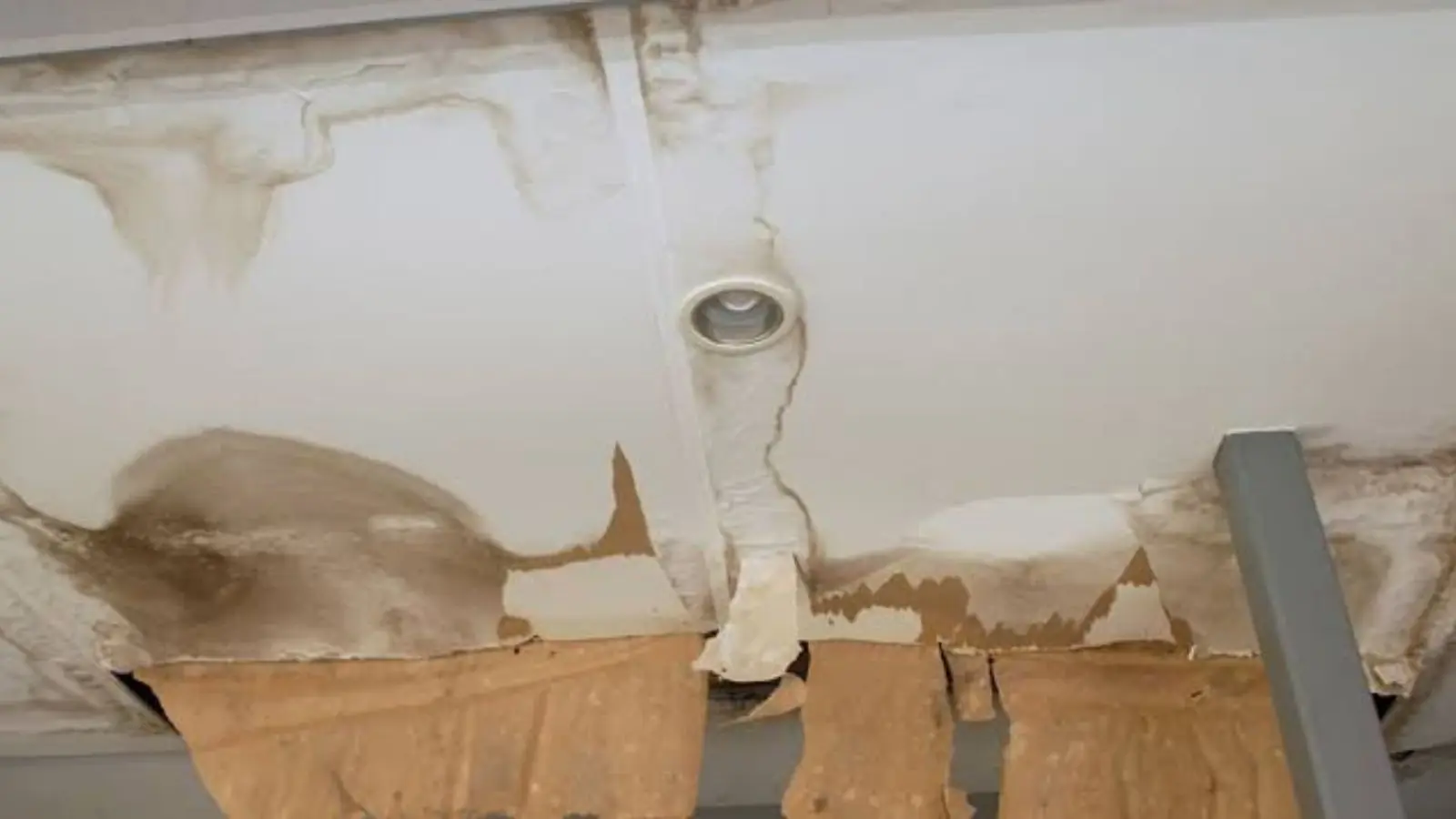
Start With the Decision, Not the Drywall Knife
Most advice on a water damaged ceiling jumps straight to patching. The better first question is whether you should be touching it at all. A ceiling holds water above your head, sits near wiring and lighting, and can fail without warning. The choices you make in the first ten minutes matter more than any repair technique.
This guide is about those choices. It covers what makes a ceiling unsafe, which problems a handy owner can reasonably take on, what a professional does differently, and the points where you should put the tools down.
Safety Checks Before Anyone Stands Under It
Sagging or bulging
A ceiling that droops, bellies or looks like a pillow is carrying trapped water. Keep people and furniture out from under it.
Active dripping
If water is still arriving, the source is not fixed and nothing you do to the surface will hold.
Light fixtures and fans
Water in a fixture is an electrical problem. Turn off the circuit at the panel before going near it, and do not touch wet fixtures.
Cracks that run in lines
Long cracks or a ceiling pulling away from the wall can mean framing is affected.
Dark or fuzzy patches
Visible growth changes the job. Treat it as a containment question, not a painting question.
If any of the first three are present, stop. Shut off the circuit, move belongings, and put a bucket under the drip. Do not poke a small hole to drain a bulge unless you can do it from a safe angle with a bucket in place, and never stand directly beneath it.
Controlled Drainage Is the Only Quick Fix Worth Doing
A bulging ceiling can release a surprising volume at once. The accepted emergency move is a small hole at the lowest point of the bulge, made with a screwdriver, with a tub below and your body to the side. This relieves weight and prevents a sudden collapse of a larger section.
Then find where the water is coming from. A roof leak, a bathroom above, a supply line or an air conditioner drain pan each need a different repair, and that is a plumbing or roofing trade, not a ceiling job. Our emergency water removal team handles the extraction and drying that follow.
Ceiling sagging or still dripping?
Call dispatch now and describe what you see.
Where DIY Makes Sense and Where It Does Not
| What you find | Reasonable owner action | Call a pro when |
|---|---|---|
| Small dry stain, source repaired long ago | Prime and repaint | The stain grows after painting |
| Stain with soft or flaking surface | Photograph and test with a meter | The board is soft through its thickness |
| Bulging or sagging section | Safe drainage, then stop | Always |
| Wet insulation above | Do not disturb | Always, since it holds water against the board |
| Wet from a bathroom or kitchen above | Shut off the fixture | The floor above is also wet |
| Visible growth | Small areas only, with protection | It covers more than a modest patch |
The pattern in that table is simple. Cosmetic work after the water is gone is a fair DIY job. Anything where water is still present, still trapped or in contact with electrical parts belongs to someone with the right equipment.
What a Professional Does That an Owner Usually Cannot
Maps the moisture
Meters and a thermal camera show the full wet area, including the attic side and the walls below.
Removes what cannot dry
Saturated board and insulation come out in clean, controlled sections, with the debris bagged.
Dries the cavity
Air movers and dehumidifiers pull moisture from framing, and readings are logged until they reach a dry standard.
Handles the aftermath
If growth is present, containment and air filtration keep it from spreading to other rooms.
Repair and finishing come after drying, never before. Rebuilding over damp framing is how a ceiling stain returns. The reasons are covered on our water damage repair page, which describes the repair side of the process.
Texture, Insulation and Hidden Hazards
Older homes in the area often have textured or popcorn ceilings. Scraping or sanding old texture can send fine debris into the air, and older material may need testing before anyone disturbs it. Ask a qualified contractor about this before sanding anything in an older house.
Wet insulation is the other trap. It sags, loses its value and keeps the board above it wet. Pulling it is not hard, but doing so after the board has failed means debris falling toward you. This is one more reason to leave overhead work to a team with protective gear.
Wheat Ridge Local Note: Permits for Structural Ceiling Work
Replacing a few sheets of drywall is cosmetic. Repairing framing, a ceiling joist or structural members is a different matter and generally calls for a permit. In Wheat Ridge, the Building Division can be reached at 303-235-2855, and option 1 is for permits. Paid contractor work in the city needs a license.
If your home sits across the line in a neighboring community, the office changes. Arvada Building Services is at 8101 Ralston Rd, 720-898-7620, and homeowners comparing service areas can read about Arvada and Denver work.
Documenting Before You Demolish
Photograph the ceiling, the stain edges and any dripping before anything is cut. Keep receipts for lodging, equipment and emergency work. The state insurance division points owners to the insurer first, before any repair begins. Ask your insurer what your policy covers.
Ceiling Water Damage FAQs for Wheat Ridge
Does ceiling work in Wheat Ridge need a permit?
Cosmetic patching usually does not, but structural repair can. Call the Wheat Ridge Building Division at 303-235-2855 and choose option 1 before cutting into framing.
Is it safe to leave a sagging ceiling until a repair crew arrives?
Keep everyone out from under it, turn off power to nearby circuits and place a bucket below. Draining a bulge safely is a judgment call, so describe it to a professional first.
Can I paint over a ceiling stain once it is dry?
Yes, once readings confirm the area is dry and the source is repaired. Prime with a stain-blocking primer. If the stain returns, the source is still active.